


Stand design for international exhibitions solves several tasks at once: standing out among hundreds of participants from different countries, quickly explaining who you are and where you come from, and creating conditions for negotiations with partners who speak other languages. Many visitors to such exhibitions arrive with a tight schedule of meetings, so the stand has to work as a business venue, not just a showcase. Let us look at what makes designing a stand for an international exhibition different from working on a local event.
How an international exhibition differs from a local one
The differences concern not only the audience but also the rules, deadlines and the way the stand operates.
- Competition for attention. Companies and national displays from different countries sit side by side in one hall, so the visual noise is higher.
- Business focus. A large share of visitors are buyers and distributors with pre-arranged meetings.
- Technical regulations. The organiser sets limits on structure height, rigging, open sides and materials.
- A mixed language environment. Navigation and materials should be clear without an interpreter.
We have covered the cultural aspects of design separately — in our articles on the impact of cultural differences on stand design and approaches to multicultural design. Here we will focus on the practical features of the design process.
National pavilion or individual stand
A company can take part as part of its country’s national display or on a separate stand. This determines the architecture, the budget and the freedom of design.
| Parameter | National pavilion | Individual stand |
| Visual style | shared by all participants, set by the display organiser | defined entirely by the company’s brand |
| What is noticed first | the country, then the company | the brand straight away |
| Participant’s space | a compact counter or module | any area within the budget |
| Shared zones | meeting areas and a coffee point for all participants | own zones only |
| Budget | part of the costs is shared between participants | the exhibitor bears all costs |

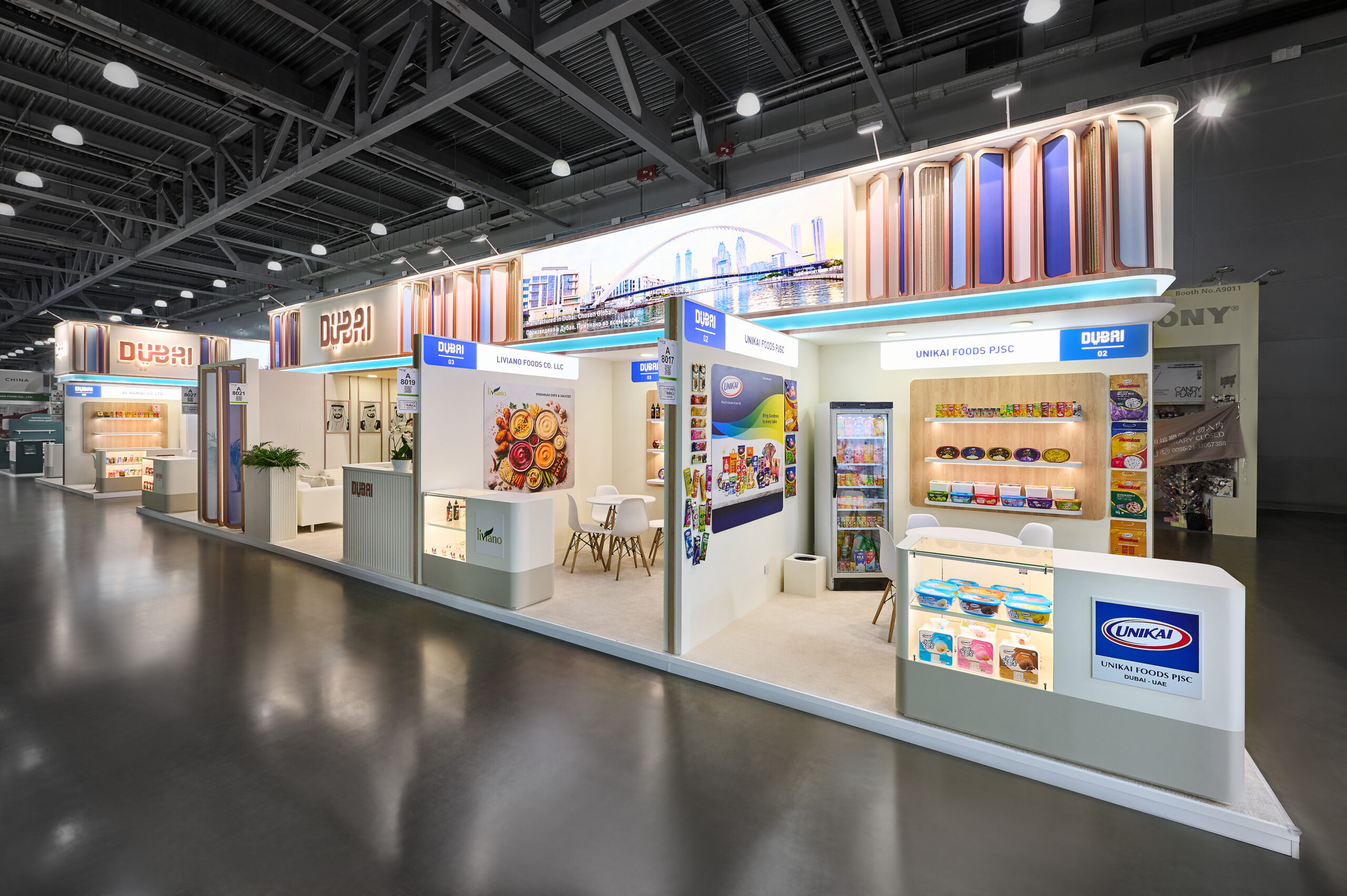
In a national display, it is important to combine the overall image of the country with clear identification of each participant. Uniform counters with space for the company’s logo and materials solve this task — as in the national display of Korea from our portfolio.
Visibility and identification in a large hall
A visitor to an international exhibition is often looking for a supplier from a specific country or industry, so the stand should be readable from a distance.
- High-level accents. Fascias, suspended structures and lighting elements are visible from distant aisles, if the regulations allow them.
- Country and brand in the foreground. The company name and country of origin should be readable from afar, not only at the counter.
- Latin script in key signage. The name and main message are duplicated in English or in the language of the host country.
- Light as a way to stand out. Contour lighting and light boxes help the stand avoid getting lost in a brightly lit hall.
Business zones and meeting scenarios
At an international exhibition, much of the value is created in negotiations, so the layout should support working to a schedule.
- Reception area. A counter at the entrance where visitors are greeted and asked about their preferred language and the purpose of their visit.
- Meeting areas with different levels of privacy. Open tables for short meetings and a closed room for discussing terms of cooperation.
- Storage room. Space for samples, documents and the personal belongings of participants who have travelled from afar.
How to combine several functions on one floor area is explained in our article on how to create a multifunctional exhibition stand.
Deadlines, regulations and manufacturing
A project for an international exhibition requires more lead time: approval by the organiser, translation of materials and logistics of structures take extra weeks.
- Early review of regulations. The venue’s technical requirements are studied before sketching begins, not after the design has been approved.
- Documents for materials. Organisers usually request fire safety certification for finishing materials.
- Structures designed for transport. Modular elements are easier to pack, deliver and install on a tight schedule.
- Time for translation and proofreading. Foreign-language versions of graphics are checked by native speakers before going to print.
Typical mistakes
- Design that ignores the regulations. The structure has to be urgently simplified at the approval stage.
- Signage only in the local language. A foreign visitor walks past without understanding what the company does.
- No space for meetings. A showcase stand cannot cope with the flow of scheduled negotiations.
- Late translation. Errors in foreign-language graphics are noticed on site, when fixing them is difficult and expensive.
Summary
The specifics of stand design for international exhibitions stem from intense competition for attention, the business nature of the audience and the organisers’ requirements. A successful stand is clearly visible from distant aisles, immediately communicates the country and the brand, speaks a language the visitor understands and provides space for negotiations. Insight Expo designs stands and national displays for international exhibitions, with structures manufactured at trusted partner production facilities.
Learn more:

How does stand color influence visitors? This article explores the psychology of shades in exhibiti...

How to design an outdoor exhibition stand: key features of construction, protection from weather co...

