



Multicultural exhibition stand design is needed when a single display has to speak equally clearly to people from different countries. National pavilions, international brands and companies entering new markets all face this task. Unlike adapting a stand for one country, here you need solutions that several audiences understand at once, while keeping the brand’s own character. Let us look at the main approaches and how to choose the right one for your project.
What multicultural stand design is
It is a design approach in which the stand takes into account the cultural background of several visitor groups at the same time. The task goes beyond translating texts: the visual language, communication scenarios and navigation should not confuse any of the key audiences.
If a stand is prepared for a specific country, targeted adaptation works — we wrote about it in our article on the impact of cultural differences on international stand design. A multicultural approach is needed when the audience is mixed and you cannot know in advance who will approach the stand next.
Four basic approaches
- Global standard. A single neutral brand design without cultural adaptation. It is easy to replicate but risks looking impersonal.
- Local adaptation. The stand is completely rebuilt around the culture of the host country. It gets a strong response but is expensive and does not suit a mixed audience.
- Hybrid model. An unchanging brand core with replaceable local layers: graphics, language, accents. The most versatile option for a series of exhibitions.
- Cultural bridge. The stand deliberately connects the exhibitor’s culture with that of the audience. A typical solution for national displays and countries presenting themselves on a foreign market.
The table helps compare the approaches.
| Approach | Adaptation costs | Brand recognition | When to choose |
| Global standard | low | high | a series of exhibitions with a uniform business audience |
| Local adaptation | high | medium | entering one priority market |
| Hybrid model | medium | high | an international tour, a mixed audience |
| Cultural bridge | medium or high | high | national pavilions, tourism, export |
How the hybrid model works
The hybrid approach requires dividing stand elements into permanent and replaceable ones in advance. This decision is made at the concept stage, not just before installation.
- Fix the unchanging core. The logo, brand palette, architectural form and key message stay the same at every exhibition.
- Define the replaceable layers. Language versions of graphics, photos, case examples, colour accents and decor change for the audience.
- Plan the replacement technology. Fabric graphics, replaceable panels and digital screens let you update the stand without rebuilding the structure.
To keep every language version readable, graphics follow shared rules of hierarchy and contrast — more on this in our article on the importance of graphic design for an exhibition stand.
National motifs without stereotypes
National displays often rely on recognisable images — ornament, architecture, nature. It is important to show the culture in a modern way and not turn the stand into a souvenir shop.
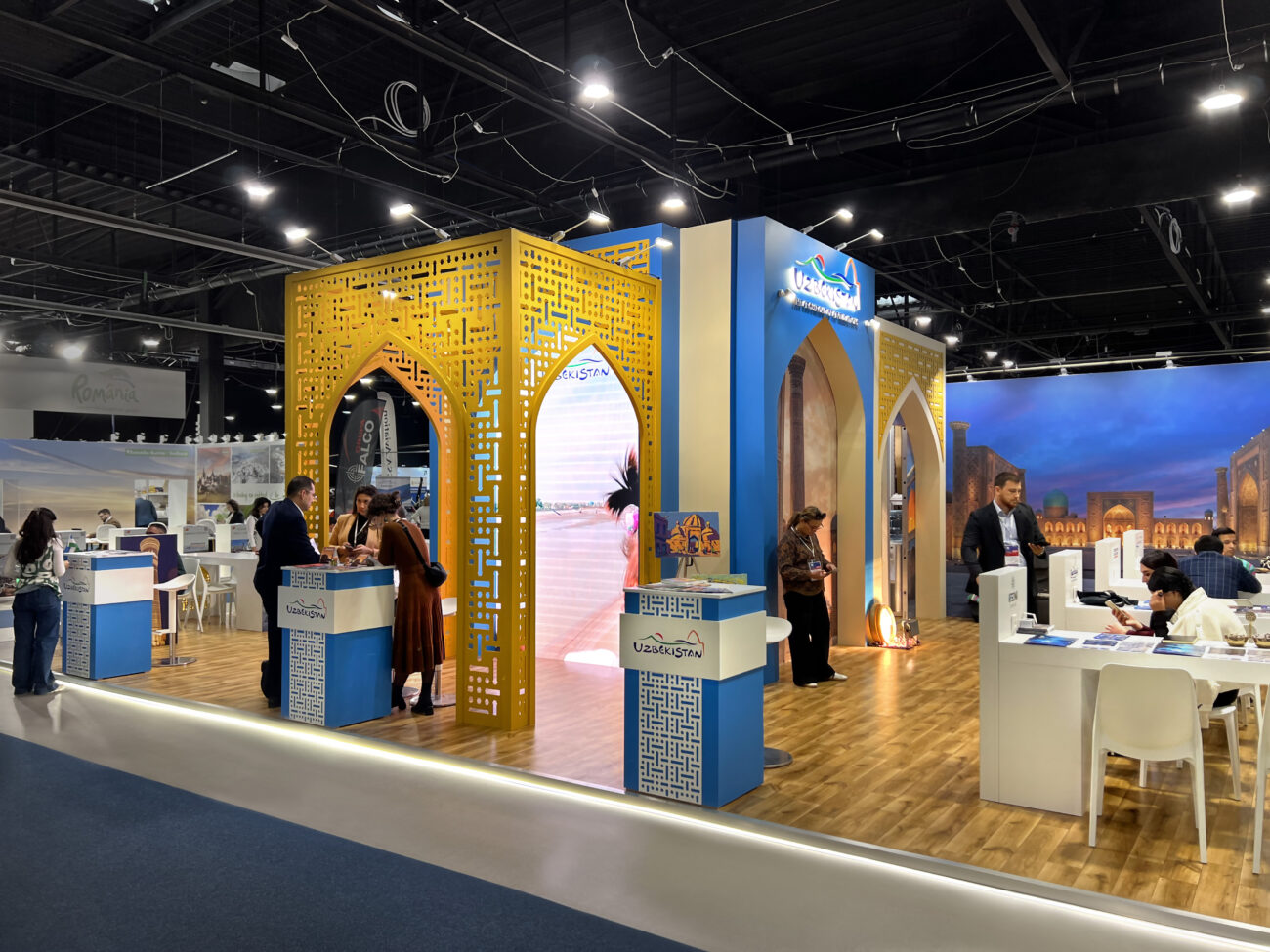
- Stylisation instead of copying. A traditional ornament turned into a modern pattern on perforated panels is perceived as a design solution rather than decoration.
- One leading motif. An arch, a pattern or a characteristic colour carried through the whole structure is stronger than a set of unrelated symbols.
- Balance with the business function. The image of the country attracts attention, but meeting counters and materials about the offer should be close by.
An example of this approach is the national display of Uzbekistan from our portfolio: the architectural arches and ornament are executed in a modern style, while participants’ counters keep a business format.
Tools for a mixed audience
Some solutions work equally well for visitors from different countries and need no separate adaptation.
- Pictograms and visual navigation. Understandable without translation and reduce the amount of text.
- Multilingual content on screens. Digital media let you switch languages without placing every version on the walls.
- QR codes with language choice. Detailed materials reach the visitor’s smartphone in the language they prefer.
- Language badges for the team. Showing which languages a staff member speaks speeds up first contact.
Typical mistakes
- Stereotypical images. A set of clichés about a country provokes irony rather than trust.
- Language overload. Five language versions on one panel make the text unreadable.
- Unchecked symbolism. Colours and signs chosen without checking may carry an unwanted meaning for part of the audience.
- Loss of the brand. Excessive adaptation dilutes the corporate style, and the stand is no longer recognisable.
Summary
Multicultural exhibition stand design starts with choosing an approach: global standard, local adaptation, hybrid model or cultural bridge. For most international projects, the hybrid model with a permanent brand core and replaceable cultural layers works best, while national displays benefit from a modern interpretation of recognisable motifs. Insight Expo designs stands for international audiences and national displays, with manufacturing carried out at trusted partner production facilities.
Learn more:
How to implement game mechanics in an exhibition booth. Gamification goals, examples for different ...
Educational elements at an exhibition stand: models, touchscreen kiosks, infographics, demonstratio...

